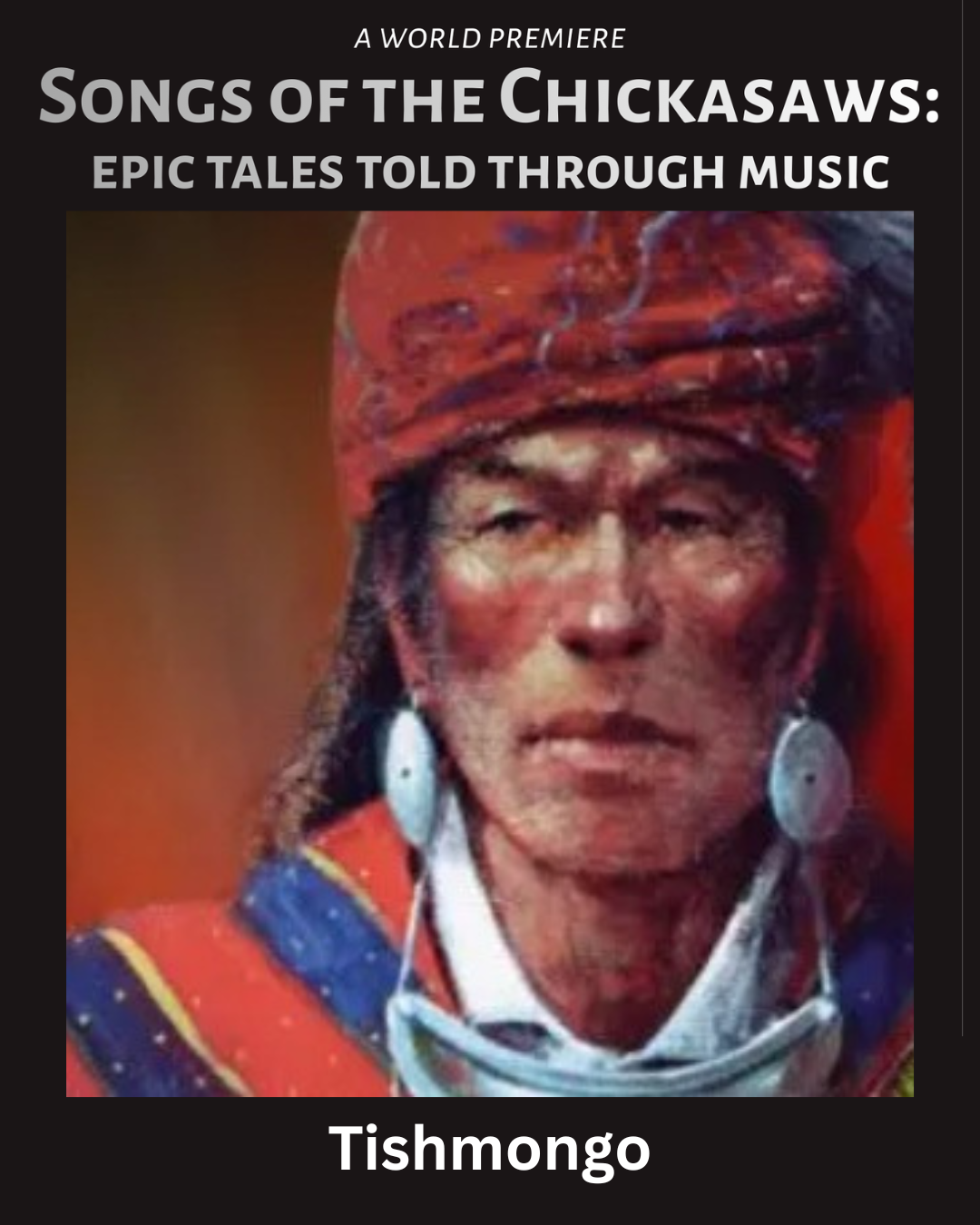
Our upcoming performance, “Songs of the Chickasaws,” is a musical homage to five legendary Chickasaw heroes. And when Brandi Berry Benson was writing the piece, she thought hard about how to turn their stories into songs.
“Every piece is very different from the other,” Benson explained.
Here is a little insight into how Benson created each of the five movements:
1. Tishu Miko — In this piece, about the last full-blood warrior chief of the Chickasaws, Benson chose to make the music resemble a death song, recalling both Tishu Miko’s war memories and his tenderness toward his people. Benson said she drew inspiration from Gustav Holst's “Mars the Bringer of War,” as well as Tchaikovsky's “War of 1812 Overture.” The piece is designed for Native flute and traverso, string quartet, hand drum, and striking sticks as well as a baritone voice that can embody a war hero in the lowe range and tenderness in the upper range.
2. Jonas Wolfe — In the second piece, which honors a governor of the Chickasaw Nation known for being stoic with "rugged integrity," Benson brings out elements of humor and love — two aspects not normally brought out in stereotypes of Native peoples. She tells the humorous story of this governor testing a young man to make sure he was worthy to marry his daughter, also using the baritone voice with Native American flute, traverso, strings, hand drum, striking sticks, and rattles.
3. Lushanya — This piece, which honors the first Native prima dona opera singer, is structured as an aria. Benson said she took the refrain text from Verdi’s “O patria mia” from Aida, which is the moment that Aida is longing for her homeland. “I also made more ‘indigenous’ recitative sections that include Chickasaw and English language and some musical word painting. I also was inspired by the aria's harmonic progression and form.”
4. “Sadie” Humes — In the fourth piece, which is a tribute to the woman who co-authored the first Chickasaw dictionary with her husband despite having little formal schooling, Benson uses a male and female singer to represent Sadie and her husband. “I use a musical beading technique with fragments of melodies from Chickasaw dances with the instruments while the two vocalists alternate calling out the words. The musical beading represents how her mind must have felt jumbled as she was finally understanding the organization and meaning of the English words. The piece ends in a Chickasaw dance that I wrote celebrating the completion of the dictionary and the continued revitalization of Chickasaw culture.”
5. Jesse Lindsey — In this fifth and final piece, about a Chickasaw flute player, Benson was inspired by a conversation she had with Jesse himself at the Chickasaw Cultural Center where he shared a story about the origin of the flute, where a woodpecker pokes holes in a river cane branch. “I composed a programmatic piece that depicts the forming of the flute and also the flute being passed on to Jesse by his collective ancestors to continue to play the flute for his people. I used the striking sticks to depict the woodpecker, the strings and flute to make the wind, and the flute begins to make fragments of music before whole phrases come out.”
Come hear all of these pieces for yourself on Feb. 28 and March 1!